
Bluelink R3 Software upgrade
We have released a new software upgrade for the Bluelink R3 (the Bluelink with the volume wheel.The following changes have been made:…
Read more →News, stories and insights from the world of Avee.

We have now released the NG versions of the Avee aviation microphones for the Bose® QC35® and for the Bose® 700 headphones.
Easier adjustments, even better attachment to the headphone and less physical size are some of the new features implemented in the NG versions of the Avee aviation microphones.
The Sony® XM1000XM3 was released in August 2018, and has proven to be a very good headset for aviation use. The comfort is according to ‘Sony standard’ and the aquistic noise cancelling – the ANR – is outstanding.
Sony released a sligtly improved XM4 version last year. On this version the comfort is still extremely good and the ANR is better than ever.
Physically the XM3 and XM4 are almost identical – it is almost impossible to see the difference between these two versions.
For all practical purposes both these headsets work very well in an aircraft – both jet, turbo prop and piston, and it is very difficult to say that that the later XM4 model is siginifically better then the XM3.
We see a gradual increase in sales on the Avee microphones for the XM3 and XM4 and this is of course the reason for shortly releasing the new and improved Avee for the XM3/XM4: the Avee XM3/4 NG.
Release date will be end of April this year.
Basically we are doing all the changes on the Avee XM3/4 NG as we have done on the Avee35 NG (started shipping starting late March 2021).
On the AveeXM3/4 NG we re using four magnets evenly spread on the surface between the headset and the Avee microphone, to keep it attached to the headphones under all conditions.
The four magnets is a solution we first used on the Avee for the Bose 700, and this has proven to be a good choice.
The fact that four magnets are used, means we can use magnets that have a smaller physial size than the two magnets we used on the previous version of the Avee for the Sony XM3/XM4. This gives a smaller physical size on the microphone itself.
The height of the microphone casing is reduced by some 15%.
 Avee Sony (pre March 2021)

On the current version of the Avee for the XM3/4, the headphone volume was adjusted using push buttons on the bottom side of the Avee microphone casing.
This solution was relatively complicated and required fairly cunning electronics inside the Avee.
On the Avee XM3/4NG we have redesigned the electronics inside the Avee to be completely analog, and the volume adjustments is now done with a dual channel potentiometer on the bottom side of the unit. The electronics inside the Avee for the XM3/4 is of course similar to the electronics inside the Avee35 NG (for the Bose QC35).
For many (or even most) pilots, the volume adjustment on the headphones is rarely used due to the fact that many aircrafts now have individual volume level adjustments for left and right seat. But on smaller aircrafts this adjustment is limited to intercom only – while the radio output level is common to both left and right seat.
In smaller GA aircrafts, the back seats do often not have individual volume adjustment possibility.
Having a good possibility to set the initial speaker level is therefor very important.
 Avee Sony (pre March 2021)

On the previous version of the Avee for the XM3/4, the microphone output level was adjusted using the volume pushbuttons on the bottome side of the case. An (annoyingly complicated) procedure was needed to set the output volume.
On the new Avee XM3/4 NG, the microphone output level is set by using a potentiometer on the under-side of the Avee. Your finger nail or the corner of a creditcard is used to set the level.
On the Avee XM3/4 NG the mono/stereo functionality is set with a separate manual switch. The same finger nail or credit card corner can be used to set.
 Avee Sony(pre March 2021)

All Avee aviation microphones are connected to the aircraft using an aircrat interface cable.
This cable is plugged into the Avee microphone in the headset end, and to the aircraft in the aircraft end. A range of aircraft conenctors are offered.
There are no interfaces or boxes on this cable – the electronics is built into the Avee microphone.
Whenever the Avee XM3/4 NG is plugged into the aircraft and receives bias voltage (the aircraft avionics is turned on), a steady discrete led is lit on the Avee to indicate that it is operational.
This is a new feature.
All Avee microphones are shipped with the new rugged microphone boom which is available in two different lengths: 145mm (standard) and 165mm.
We have released a new software upgrade for the Bluelink R3 (the Bluelink with the volume wheel.The following changes have been made:…
Read more →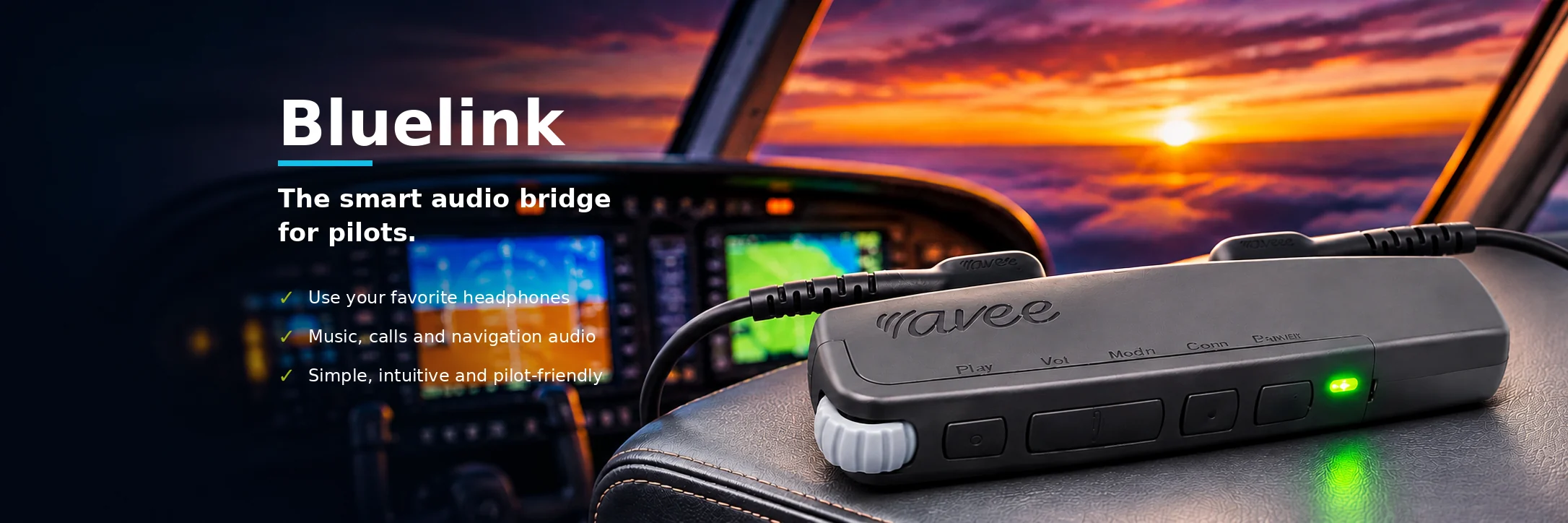
Happy New Year to all of you! Thank you for all your support throughout 2025 !All those wonderful (and long) phone conversations…
Read more →The Avee-year 2025 was extremely busy for us. We see a steady increase in the number of sold units, and we are…
Read more →Between shuffling huge amounts of snow in Preisssac ( Quebec, Canada) and eating poutine (the most ‘interesting’ Quebecois meal (see picture (if…
Read more →Since the Sony WH1000XM6 (XM6 for short) came this summer, we have wanted to make an adapter to fit it. Unfortunately, we…
Read more →We are making videos! We have finally come to the point where we wanted to be some years ago: having enough time…
Read more →Read more about the Avee Bluelink R3 here !In full production – and we are working as fast as we can to…
Read more →
SHIPMENTS TO THE USA August the 29th 2025, the threshold of USD 800 before adding sales tax & tariffs , was removed.…
Read more →We are now up and running with tracked surface mail shipping to all European countries, including Spain and Portugal (we initially had…
Read more →